Most rural development interventions fail because they try to solve one problem while ignoring five others. A road without a market leads nowhere useful. A processing facility without power sits idle. A training programme without capital access produces skilled people with no way to act on their skills.
TransComs are designed differently.
The Cluster Model
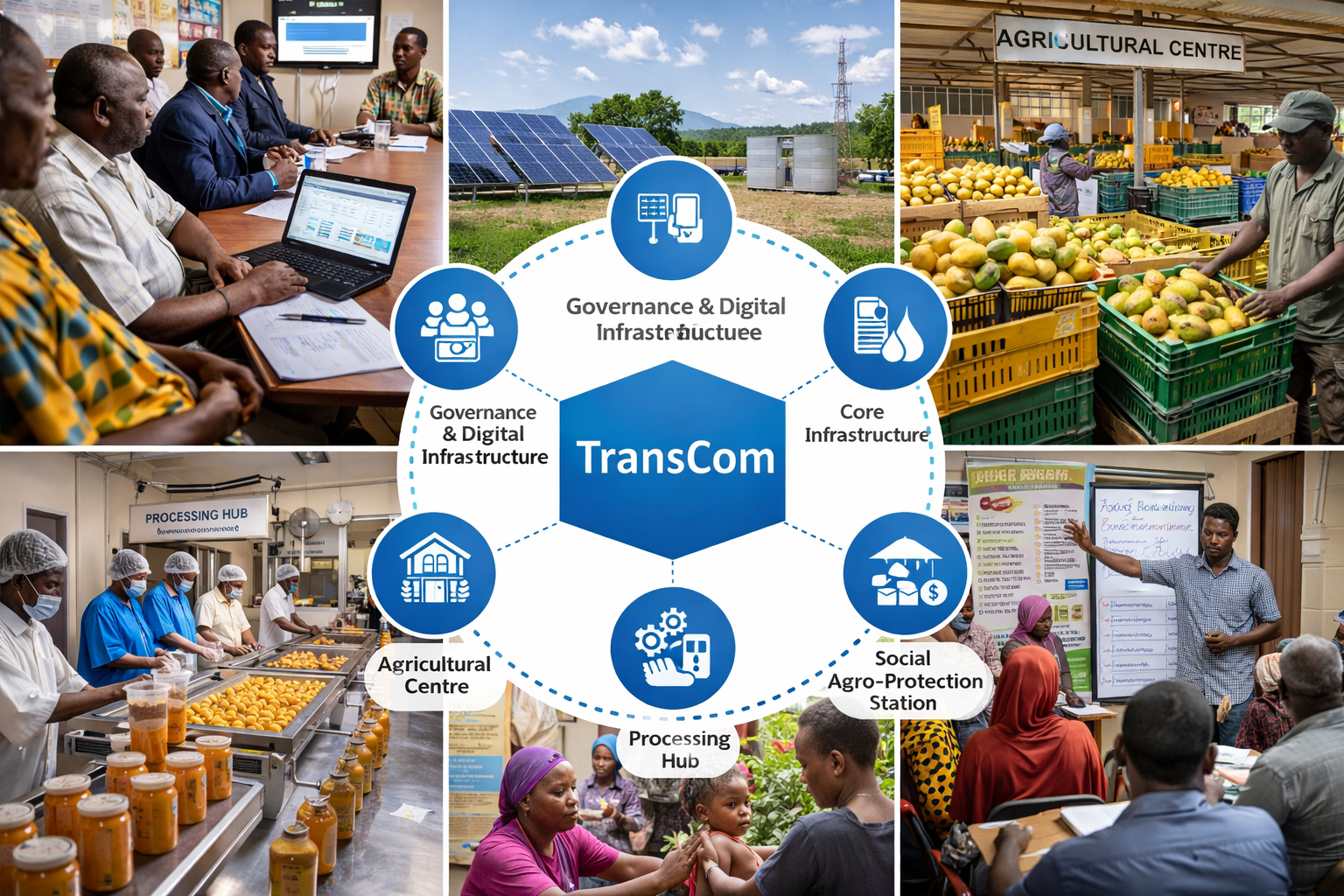
Each TransCom — short for Transformed Community — is built to a single specification: six integrated pillars, co-located on one site, designed to work together. The combination is what makes it transformative.
Pillar 1: Governance & Digital Infrastructure
Every TransCom is governed by a Community Transformation Board, including traditional authority, cooperative leaders, women's associations, and an SWDC nominee. A digital dashboard provides real-time transparency.
Pillar 2: Core Infrastructure
Reliable power (solar hybrid mini-grid), clean water (borehole with treatment), road access, and 4G/LTE connectivity. Without these, nothing else works.
Pillar 3: Agricultural Centre (TAC)
The farm-to-market bridge — aggregation, grading, cold storage, and quality certification to NAFDAC/SON standards.
Pillar 4: Processing Hub (TPH)
Value-added manufacturing — juicing, drying, milling, oil extraction — with packaging and export linkages via Special Agro-Processing Zones.
Pillar 5: Social Agro-Protection Station (SAPS)
Community infrastructure for the most vulnerable: women's cooperatives, child nutrition, social safety nets, and disability-inclusive design.
Pillar 6: Skills & Microfinance Centre
Vocational training, digital literacy, TVET certification, microfinance, and a youth entrepreneurship incubator.
Why It Works
The evidence from decades of development research is clear: isolated interventions do not move the needle on rural poverty. What works is co-location — putting complementary infrastructure together so that the whole is more valuable than the sum of its parts.
TransComs is that model, adapted for the specific crops, cooperatives, and community structures of Southwest Nigeria. The goal: 137 clusters across six states by 2031.